
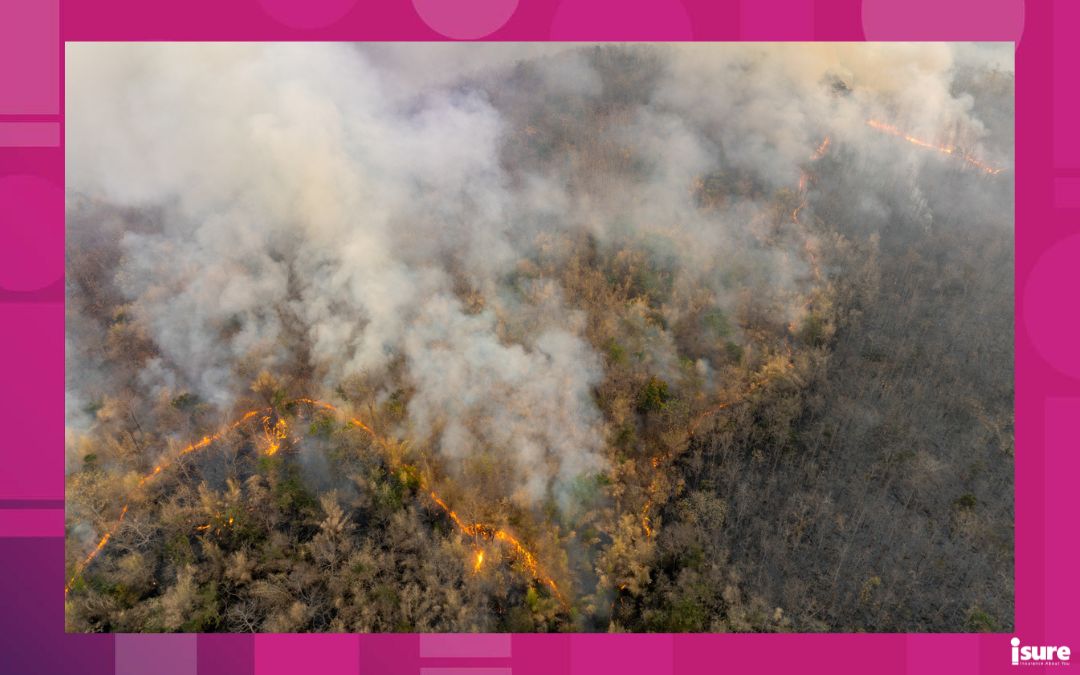
The wildfires have been an aggressive force in various parts of Canada. A recent report from the Earth System Science Journal (ESSD) shows that a repeat of last year’s wildfire season is six times more likely by 2100. This trajectory is if no action is taken to tackle greenhouse gas emissions. This means that if nothing changes, ESSD believes the Canadian wildfires for years to come can be much worse. Let’s take a look at the statistics and how this can affect people.
Wildfire season to repeat for people born this decade
According to the report by the Earth System Science Data Journal, Canadians born this decade will certainly see a wildfire season similar to the one in 2023 at least once again in their lifetime. Specifically, 65% to 90% if they live to at least age 83. There is also a 48% to 84% chance they’ll see it twice. To put this into perspective, a Canadian who reached age 83 before the end of the 2010s had only a 12% chance of seeing a wildfire season as bad as the one in 2023 in their lifetime. With this being said, Canada may instead see the likelihood of extreme fire season increase only two-fold by 2100 under a low emissions scenario.
“Whatever emissions scenario we follow, risks of the extreme wildfires will increase in Canada, highlighting that society must not only cut emissions but also adapt to changing wildfire risks,” Douglas Kelley tells the Canadian Underwriter. Kelley is a land surface modeler and one of the researchers of the ESSD report.
Climate change made last year’s Canadian wildfires more likely
The University of East Anglia states climate change played a huge role in last year’s unprecedented Canadian wildfire season. It made it three times more likely to happen. After the fact, the burn season contributed to high levels of CO2 emissions from burning globally.
Last year, over 6,623 separate wildfires burned 18.4 million hectares of land during the season, according to National Resources Canada. Additionally, emissions from Canadian wildfires were over nine times the average of the past two decades. Together, this contributed to almost a quarter of last year’s total of 8.6 billion tonnes of global emissions. To compare, the ten-year average of Canada wildfires is 4,394, or just over 3 million hectares, burned every year.
Canada Wildfires: Where are we now?
Currently, Canada has 4,246 wildfires burning across the nation. In the last week, over 2.9 million hectares have burned. Last year, the peak time for wildfire season happened in June for the east coast of the country, with August to September being the peak time for the west coast. To add to this, over 232,000 people were evacuated in Canada alone. This does not even include the business interruption impact that insurers felt during this time.
The report from National Resources Canada shows that the affected areas were 40% higher due to climate change in Canada. They also added that human-driven climate change means the likelihood of high-fire weather and wildfires increased 2.9 to 3.6 times.
How will this season’s wildfires continue?
The research from National Resources Canada states that the outlook for 2024 shows a “moderate” fire season that would have peaked earlier in the summer. With this year’s area already approaching the seasonal 10-year average, Canada is once again expected to surpass it. However, they can potentially burn for much longer.
Currently, ongoing fires are affecting British Columbia. The province has over 400 active wildfires as of the publishing of this article. Alberta, on the other hand, has 126 active fires, mainly in Jasper. Additionally, Natural Resources Canada indicates that out-of-control wildfires are also burning through the territories and prairies. Researchers state that hot, dry, and windy conditions that are apparent in North America create favourable Canadian wildfire conditions. This is especially the case in western provinces.
Canada Wildfires: A conclusion
As of now, forecasting the risk of wildfires is still an ongoing area of research. Last year, early indications of extreme fire weather were predicted only two months in advance. With the devastating wildfires in LA continuing to In the meantime, it is best to stay safe and always double-check if you are insured in the event of a wildfire. Additionally, be sure to follow our wildfire safety and prevention tips to keep safe during peak season!

Experiencing wildfires in your area? Follow our wildfire prevention tips Read more

Wildfires aren't just affecting our air quality. Let's examine how Read more

Canada is experiencing its most destructive wildfire season on record, Read more