

If you pull up to a busy intersection, chances are there’s a red-light camera tucked away, just waiting to catch drivers in the act of running red lights. Red-light cameras are there to act as a deterrent and catch drivers who run red lights. We’ve done some research and made a list of where the red light cameras are in your neck of the woods. We’ve broken down each of the eight municipalities that are currently utilizing red light cameras in Ontario to help reduce the number of accidents and injuries from red light runners. Keep on reading to find out where to find RLCs in your city!
Red light cameras in Ontario
There are currently over 300 red light cameras in use in municipalities across the province of Ontario, with about half of them located in Toronto. The following are cities that currently use red light cameras in Ontario:
- Toronto – 149 cameras
- Ottawa – 75 cameras
- Peel Region (Brampton & Mississauga) – 33 cameras
- Hamilton – 42 cameras
- London – 9 cameras
- Region of Waterloo (Kitchener/Waterloo/Cambridge) – 16 cameras
- Sudbury – 6 cameras
Toronto
In February 2023, the City of Toronto revealed the location of 25 new speed cameras which began issuing tickets in March. The cameras will join the existing cameras currently operating across Toronto. The city is home to over 150 red light cameras to help catch lead-footed drivers. According to the city, red light cameras are effective at reducing serious collisions. Data collected between 2008 and 2014 shows injuries at intersections where the devices were installed decreased by 23 percent, and fatal collisions fell by 40 percent. As a result, more cameras are coming! This is part of Vision Zero 2.0, the second iteration of its road safety plan aimed at eliminating traffic deaths. Council approved the new five-year, $123-million road safety plan amid the concern that the original version, passed in 2016, wasn’t doing enough to curb fatalities. Mayor John Tory has strongly backed the camera program’s expansion.
Ottawa
In our nation’s capital, you may find yourself navigating through 75 red-light camera intersections on your commute home. The program, which began in 2001 with seven red light cameras throughout the city, had expanded to 67 cameras by October 2021. The Red Light Camera Program expansion is on track to install 84 cameras. Knowledge and awareness of red light cameras reduce the risk of aggressive driving, according to the City of Ottawa. “Red light cameras have led to a reduction of more than 50 percent in dangerous right-angle collisions, as well as an overall decrease of 43 percent in injuries,” Ottawa Mayor, Jim Watson, says. The cameras are installed at intersections based on collision data, which is reviewed annually.
To learn more about where the RLCs can be found in your neighbourhood, click here.
Region of Peel (Mississauga/Brampton)
The region of Peel, consisting of Mississauga and Brampton, is no stranger to traffic woes. Up until recently, Brampton had the highest auto insurance premiums in the province (Vaughan now holds this dubious honour). As of 2019, the region had a total of 33 red light cameras installed. The program was originally implemented in an attempt to reduce accidents. Peel region has since seen a 44.8 percent reduction for all collision types at those intersections. The intersections currently part of the program were selected based on high incidences of right-angle crashes. These types of accidents tend to be the most dangerous and often result in fatal injuries to both drivers and passengers. Experts maintain that RLCs are effective and help to prevent these crashes. After all, the cameras are there to dissuade drivers from running reds and ultimately causing an accident.
Hamilton
While Hamilton already has 32 red light cameras in operation, the public works committee has recently approved red light cameras at another 10 Hamilton intersections this year. This will bring the region’s total to 42 RLCs. The additional cameras will be installed at trouble spots throughout the mountain and suburban communities, pending final approval from the City Council. Roads Manager, Mike Field, says they’ve been “very successful” at reducing collisions that result in injury or death by about 65 percent. Field also says the city has added about five locations each year, but this year’s new cameras will be the first since before the pandemic.
Red light cameras installed in Hamilton:
- Paramount Drive and Winterberry Drive
- Highway 8 and Gray Road
- Barton Street and Fruitland Road
- Upper James Street and Airport Road
- Garner Road East and Southcote Road
According to CBC, there has been a 25% reduction in the number of angle collisions that result in fatalities and serious injuries and a 17 percent reduction overall in angle collisions resulting in damage only to the vehicles involved.
London
London is utilizing a mixture of different types of safety cameras including speed cameras, red light cameras, and average camera systems to decrease accidents. Camera installations hope to target intersections with a higher KSI (killed or seriously injured) history due to drivers going too fast or running red lights. Shane Maguire, who manages the program for the city, believes the cameras are having a positive effect. “From driving around the city, I’ve seen drivers perhaps obeying the signals a bit better than they used to,” he says. Hamilton made an effort to spread the cameras throughout the city, given that red light cameras can provoke a ‘halo effect.’ The introduction of cameras tends to improve people’s driving behaviour the city has found.
To view all the red light cameras in London, click here.
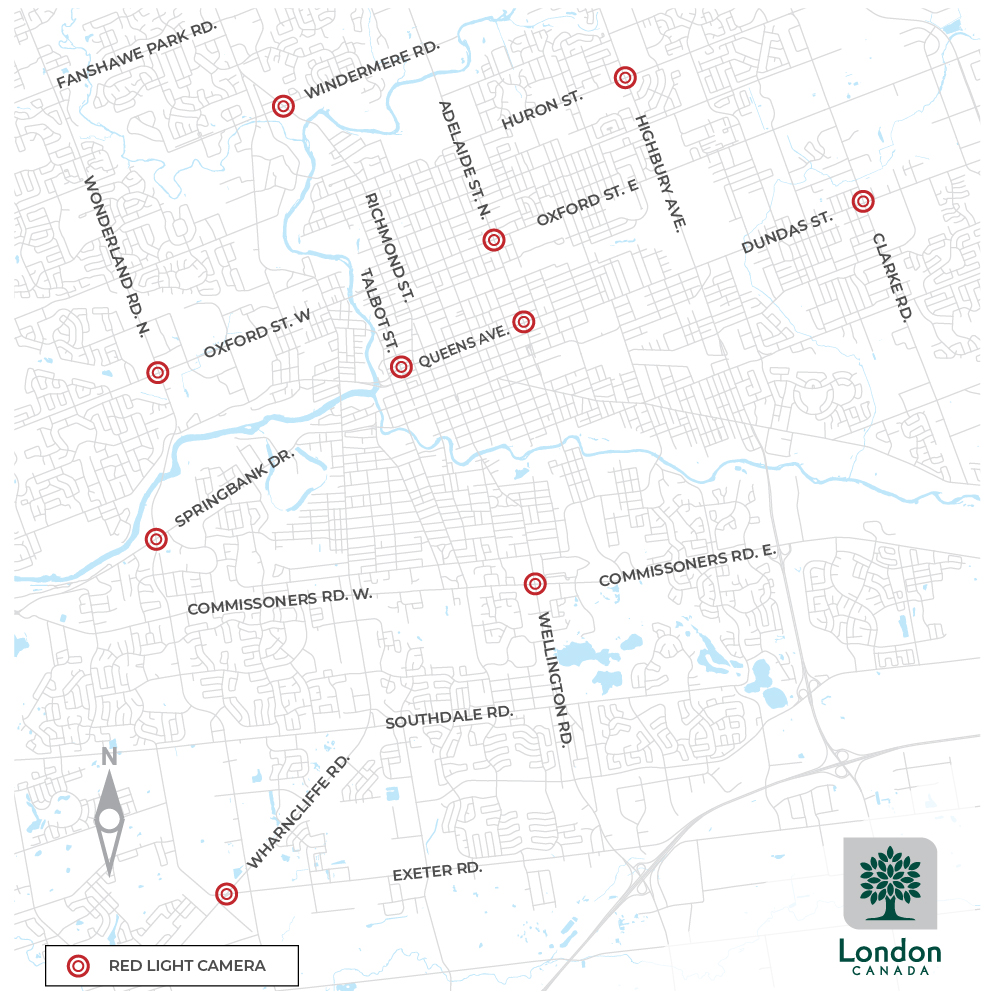
Photo via london.ca
The Region of Waterloo (Cambridge/Kitchener/Waterloo)
The region first installed red light cameras in 2000, saying it would increase safety at problem intersections by dissuading drivers from running red lights. In 2005, the number of cameras was increased to 16. The program is not without its challenges. The region reported back in 2016 that 10,017 photos were taken at red light camera intersections. Of those, only two-thirds resulted in tickets. According to Bob Henderson, Manager of Transportation Engineering, tickets weren’t issued because licence plates were obstructed, the paint was worn on the stop bar on the pavement, or the stop bar was not visible. “The car has to be visibly intruding upon the intersection,” Henderson said.
The Region’s RLC program has resulted in the following outcomes:
- Reduced angle collisions caused by disobeying traffic control by 27%
- Reduced turning collisions caused by disobeying traffic control by 60%
- Increased rear-end collisions by 23%
Sudbury, Ontario
Red light cameras have been a topic of discussion in Sudbury Council chambers since at least 2018 when a city-wide Road Safety Assessment determined red-light running was a contributor toward serious collisions in the city. “We have an epidemic of people running red lights in Sudbury,” Ward 5 Coun. Robert Kirwan said during several council meetings. “These (cameras) are going to be very beneficial in making our intersections safe.” The cameras will only issue tickets for running red lights and will not target speeders.
Windsor, Ontario
In Ontario, red light cameras are located at specific intersections in various cities and regions, with some new locations being added in 2025. In Windsor, for instance, 10 new camera locations will be operational this spring, including Lauzon Parkway at Tecumseh Road East and Provincial Road at Walker Road. The Niagara Region also has red light cameras at various locations, such as Fort Erie, Grimsby, and Niagara Falls.
Those 10 new red-light camera intersections in Windsor are:
- Lauzon Parkway at Tecumseh Road East
- Provincial Road at Walker Road
- Lauzon Parkway at Forest Glade Drive
- Central Avenue at North Service Road/Temple Drive
- Northwood Street at Dominion Boulevard
- Labelle Street at Dominion Boulevard
- Tecumseh Road East at Pillette Road
- Lauzon Line at Lauzon Parkway
- Wyandotte Street West at Crawford Avenue
- Tecumseh Road East at Jefferson Boulevard
Going global – Worldwide RLC locator
If you find yourself driving in a new city or country, photoenforced.com may be your new favourite navigation site. This is especially the case if you are uninformed with the locations of red light cameras. It is a user-generated or crowd sourced database of photo enforced and traffic camera locations. This started which started out in 2001 and has been growing rapidly since. The open database of locations and fines is continually updated by anonymous users from around the world. The majority of the database currently contains data on where to find RLCs and speed cameras. The database consists of more than 26,000+ locations, and is changing and growing every day. The site currently tracks red light cameras, speed cameras, toll road cameras, traffic cameras and automatic licence plate reader cameras.
What is the cost of a Red-light Ticket in Ontario?
In Ontario, a red light camera ticket will cost the vehicle owner $325. This includes a $260 base fine, a $60 victim surcharge, and a $5 court fee. Red light camera tickets are issued to the registered owner of the vehicle, not the driver. These tickets do not result in demerit points being added to the driver’s abstract.
A red-light camera ticket is considered a fine, not a major conviction. The fine in Ontario is $325. Red light camera tickets generally won’t impact your insurance premium because you won’t get demerit points issued with the ticket, which means the ticket won’t show up on your driving record for your insurance company to see. If you receive a red-light ticket from a police offer, however, you’ll likely receive demerit points, which will show up on your driving record. This will likely lead to an increase in your premium. Plus, you could get a conviction registered on your driving history for three years.
Basically, running a red light is never advised, however, knowing where to find the RLCs may help you rethink your driving approach. Knowing where the cameras are helps you plan ahead to slow down before reaching the intersections in order to avoid your photo being taken and later finding a ticket in your mailbox. But more importantly, by not running red lights, you are helping to curb the number of traffic accidents, injuries and fatalities in Ontario. Keeping our streets a safe place for all to use is priceless!
Got a ticket from a red light camera?
It could impact your insurance. Get a quick car insurance quote today to see how your rates stack up—and explore ways to save!


With city council approving the extension of the Red Light Read more

With more RLCs being installed at some of the GTA's Read more
Got a speeding ticket? Here’s what it could mean for Read more